> Source: https://www.ymotongpoo.com/works/otel-specs-ja/semconv/general/attributes/
# General attributes
**ステータス**: [Development][DocumentStatus]
この節で説明する属性は、特定の操作に固有のものではなく、汎用的なものです。
これらは、適用可能なあらゆるスパンで使用できます。
個々の操作は、これらの属性のいくつかを参照または要求することがあります。
## サーバー、クライアント、共有ネットワーク属性
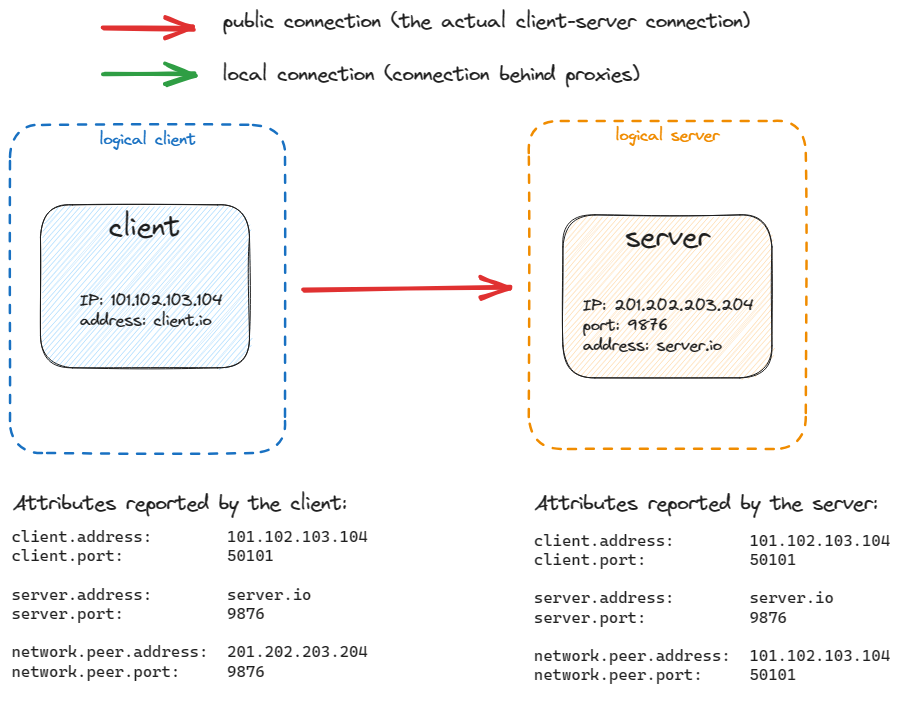
理想的な状況(プロキシや複数のIPアドレス・ホスト名がない状況)では、`server.*` 属性はクライアント側とサーバー側で同じです。
### アドレスとポートの属性
すべてのIPベースのプロトコルにおいて、「アドレス」はIPレベルのアドレスのみとするべきです。
プロトコル固有のアドレス部分は、適用可能な場合、TCPとUDPの「ポート」属性のような別の属性に分割されます。
このようなトランスポート固有の情報が収集され、かつ属性名からトランスポートが一意に識別できない場合は、特に [`network.transport`](#その他のネットワーク属性) を設定することが推奨されます。
### サーバー属性
**Status:** 
これらの属性は、接続を開始する側であるクライアントが存在する、接続ベースのネットワーク相互作用においてサーバーを記述するために使用できます。これは、TCPが接続ベースであり一方の側が接続を開始するため、すべてのTCPネットワーク相互作用に当てはまります(例外として、プロトコル・APIの「ユーザー向け」の表面にクライアントとサーバーの明確な区別がないTCP上のピアツーピア通信があります)。これは、一方の側が相互作用を開始するUDPネットワーク相互作用(QUIC(HTTP/3)やDNSなど)にも当てはまります。
**Attributes:**
| Key | Stability | [Requirement Level](/works/otel-specs-ja/semconv/general/attribute-requirement-level/) | Value Type | Description | Example Values |
| --- | --- | --- | --- | --- | --- |
| [`server.address`](https://opentelemetry.io/docs/specs/semconv/registry/attributes/server/) |  | `Recommended` | string | 利用可能であればリバースDNSルックアップなしのサーバードメイン名。それ以外の場合はIPアドレスまたはUNIXドメインソケット名。[1] | `example.com`; `10.1.2.80`; `/tmp/my.sock` |
| [`server.port`](https://opentelemetry.io/docs/specs/semconv/registry/attributes/server/) |  | `Recommended` | int | サーバーのポート番号。[2] | `80`; `8080`; `443` |
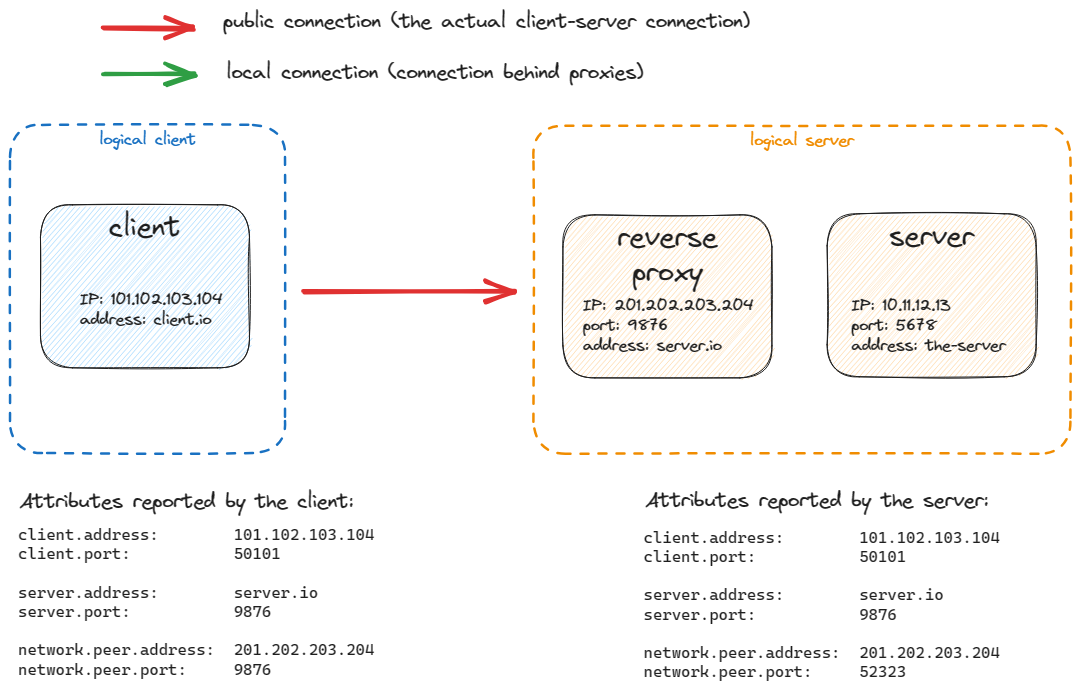
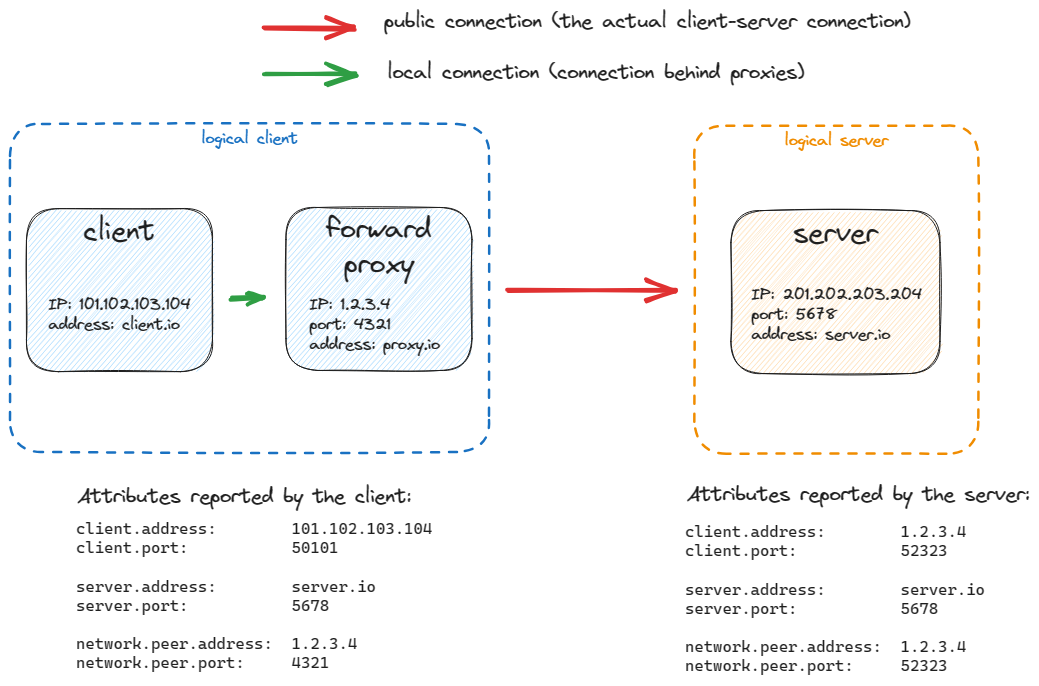
**[1] `server.address`:** クライアント側から観測し、かつ中継者(例えばプロキシ)を経由して通信している場合、`server.address` は、利用可能であれば、その中継者の背後にあるサーバーアドレスを表すべきです(SHOULD)。
**[2] `server.port`:** クライアント側から観測し、かつ中継者(例えばプロキシ)を経由して通信している場合、`server.port` は、利用可能であれば、その中継者の背後にあるサーバーポートを表すべきです(SHOULD)。
`server.address` と `server.port` は、論理的なサーバー名とポートを表します。
これらの属性を参照するセマンティック規約は、それぞれの文脈でこれらの属性が何を意味するのかを規定すべきです(SHOULD)。
#### `server.address`
IPベースの通信の場合、名前はサービスのDNSホスト名であるべきです。
クライアント側ではリモートサービス名と一致し、サーバー側では外部のクライアントから見えるローカルサービス名を表します。
URL `https://example.com/foo` に接続する場合、`server.address` はクライアント側とサーバー側の両方で `"example.com"` と一致します。
クライアント側では、通常はURL、接続文字列、ホスト名などの形式で渡されます。
ホスト名が、DNS名またはIPアドレスを含みうる文字列として計装にしか渡されないこともあります。
`server.address` は、利用可能な既知のホスト名に設定すべきです(SHOULD)(例えば、URL `https://127.0.0.1/foo` に接続する場合は `"127.0.0.1"`)。
IPアドレスしか利用できない場合は、それを `server.address` に設定すべきです。
DNS名の取得にリバースDNSルックアップを使用すべきではありません(SHOULD NOT)。
`network.transport` が `"pipe"` の場合、それを表すファイルの絶対パスを `server.address` として使用すべきです。
そのようなファイルがない場合(例えば無名パイプの場合)、名前が単に不明であるケースや計装で対応されていないケースと区別するために、明示的に空文字列に設定すべきです。
UNIXドメインソケットの場合、`server.address` 属性は、クライアント側ではリモートエンドポイントのアドレスを、サーバー側ではローカルエンドポイントのアドレスを表します。
### クライアント属性
**Status:** 
これらの属性は、接続を開始する側であるクライアントが存在する、接続ベースのネットワーク相互作用においてクライアントを記述するために使用できます。これは、TCPが接続ベースであり一方の側が接続を開始するため、すべてのTCPネットワーク相互作用に当てはまります(例外として、プロトコル・APIの「ユーザー向け」の表面にクライアントとサーバーの明確な区別がないTCP上のピアツーピア通信があります)。これは、一方の側が相互作用を開始するUDPネットワーク相互作用(QUIC(HTTP/3)やDNSなど)にも当てはまります。
**Attributes:**
| Key | Stability | [Requirement Level](/works/otel-specs-ja/semconv/general/attribute-requirement-level/) | Value Type | Description | Example Values |
| --- | --- | --- | --- | --- | --- |
| [`client.address`](https://opentelemetry.io/docs/specs/semconv/registry/attributes/client/) |  | `Recommended` | string | クライアントアドレス。利用可能であればリバースDNSルックアップなしのドメイン名。それ以外の場合はIPアドレスまたはUNIXドメインソケット名。[1] | `client.example.com`; `10.1.2.80`; `/tmp/my.sock` |
| [`client.port`](https://opentelemetry.io/docs/specs/semconv/registry/attributes/client/) |  | `Recommended` | int | クライアントのポート番号。[2] | `65123` |
**[1] `client.address`:** サーバー側から観測し、かつ中継者(例えばプロキシ)を経由して通信している場合、`client.address` は、利用可能であれば、その中継者の背後にあるクライアントアドレスを表すべきです(SHOULD)。
**[2] `client.port`:** サーバー側から観測し、かつ中継者(例えばプロキシ)を経由して通信している場合、`client.port` は、利用可能であれば、その中継者の背後にあるクライアントポートを表すべきです(SHOULD)。
### 送信元と宛先の属性
#### 送信元
**Status:** 
これらの属性は、ネットワーク交換・パケットの送信者を記述するために使用できます。これらは、両者の間にクライアント・サーバーの関係がない場合、またはその関係が不明な場合に使用すべきです。これは、接続があったかどうか、どちらの側が開始したかが分からない低レベルのネットワーク相互作用(パケットトレースなど)に当てはまります。これは、単方向のUDPフローや、プロトコル・APIの「ユーザー向け」の表面にクライアントとサーバーの明確な区別がないピアツーピア通信にも当てはまります。
**Attributes:**
| Key | Stability | [Requirement Level](/works/otel-specs-ja/semconv/general/attribute-requirement-level/) | Value Type | Description | Example Values |
| --- | --- | --- | --- | --- | --- |
| [`source.address`](https://opentelemetry.io/docs/specs/semconv/registry/attributes/source/) |  | `Recommended` | string | 送信元アドレス。利用可能であればリバースDNSルックアップなしのドメイン名。それ以外の場合はIPアドレスまたはUNIXドメインソケット名。[1] | `source.example.com`; `10.1.2.80`; `/tmp/my.sock` |
| [`source.port`](https://opentelemetry.io/docs/specs/semconv/registry/attributes/source/) |  | `Recommended` | int | 送信元のポート番号 | `3389`; `2888` |
**[1] `source.address`:** 宛先側から観測し、かつ中継者(例えばプロキシ)を経由して通信している場合、`source.address` は、利用可能であれば、その中継者の背後にある送信元アドレスを表すべきです(SHOULD)。
#### 宛先
**Status:** 
これらの属性は、ネットワーク交換・パケットの受信者を記述するために使用できます。これらは、両者の間にクライアント・サーバーの関係がない場合、またはその関係が不明な場合に使用すべきです。これは、接続があったかどうか、どちらの側が開始したかが分からない低レベルのネットワーク相互作用(パケットトレースなど)に当てはまります。これは、単方向のUDPフローや、プロトコル・APIの「ユーザー向け」の表面にクライアントとサーバーの明確な区別がないピアツーピア通信にも当てはまります。
**Attributes:**
| Key | Stability | [Requirement Level](/works/otel-specs-ja/semconv/general/attribute-requirement-level/) | Value Type | Description | Example Values |
| --- | --- | --- | --- | --- | --- |
| [`destination.address`](https://opentelemetry.io/docs/specs/semconv/registry/attributes/destination/) |  | `Recommended` | string | 宛先アドレス。利用可能であればリバースDNSルックアップなしのドメイン名。それ以外の場合はIPアドレスまたはUNIXドメインソケット名。[1] | `destination.example.com`; `10.1.2.80`; `/tmp/my.sock` |
| [`destination.port`](https://opentelemetry.io/docs/specs/semconv/registry/attributes/destination/) |  | `Recommended` | int | 宛先のポート番号 | `3389`; `2888` |
**[1] `destination.address`:** 送信元側から観測し、かつ中継者(例えばプロキシ)を経由して通信している場合、`destination.address` は、利用可能であれば、その中継者の背後にある宛先アドレスを表すべきです(SHOULD)。
### その他のネットワーク属性
> [!IMPORTANT]
> この節の属性は、HTTPセマンティック規約で使用されています。
> HTTPセマンティック規約が安定版として宣言された後は、この節の属性への変更は、HTTPセマンティック規約に破壊的変更をもたらさない場合にのみ許可されます。
**Attributes:**
| Key | Stability | [Requirement Level](/works/otel-specs-ja/semconv/general/attribute-requirement-level/) | Value Type | Description | Example Values |
| --- | --- | --- | --- | --- | --- |
| [`network.local.address`](https://opentelemetry.io/docs/specs/semconv/registry/attributes/network/) |  | `Recommended` | string | ネットワーク接続のローカルアドレス。IPアドレスまたはUNIXドメインソケット名。 | `10.1.2.80`; `/tmp/my.sock` |
| [`network.local.port`](https://opentelemetry.io/docs/specs/semconv/registry/attributes/network/) |  | `Recommended` | int | ネットワーク接続のローカルポート番号。 | `65123` |
| [`network.peer.address`](https://opentelemetry.io/docs/specs/semconv/registry/attributes/network/) |  | `Recommended` | string | ネットワーク接続のピアアドレス。IPアドレスまたはUNIXドメインソケット名。 | `10.1.2.80`; `/tmp/my.sock` |
| [`network.peer.port`](https://opentelemetry.io/docs/specs/semconv/registry/attributes/network/) |  | `Recommended` | int | ネットワーク接続のピアポート番号。 | `65123` |
| [`network.protocol.name`](https://opentelemetry.io/docs/specs/semconv/registry/attributes/network/) |  | `Recommended` | string | [OSIアプリケーション層](https://wikipedia.org/wiki/Application_layer)またはそれに相当する非OSI層。[1] | `amqp`; `http`; `mqtt` |
| [`network.protocol.version`](https://opentelemetry.io/docs/specs/semconv/registry/attributes/network/) |  | `Recommended` | string | ネットワーク通信で使用されているプロトコルの実際のバージョン。[2] | `1.1`; `2` |
| [`network.transport`](https://opentelemetry.io/docs/specs/semconv/registry/attributes/network/) |  | `Recommended` | string | [OSIトランスポート層](https://wikipedia.org/wiki/Transport_layer)または[プロセス間通信方式](https://wikipedia.org/wiki/Inter-process_communication)。[3] | `tcp`; `udp` |
| [`network.type`](https://opentelemetry.io/docs/specs/semconv/registry/attributes/network/) |  | `Recommended` | string | [OSIネットワーク層](https://wikipedia.org/wiki/Network_layer)またはそれに相当する非OSI層。[4] | `ipv4`; `ipv6` |
**[1] `network.protocol.name`:** 値は小文字に正規化すべきです(SHOULD)。
**[2] `network.protocol.version`:** プロトコルバージョンが(例えば[ALPN](https://www.rfc-editor.org/rfc/rfc7301.html)を使って)ネゴシエーションされる場合、この属性はネゴシエーションされたバージョンに設定すべきです(SHOULD)。実際のプロトコルバージョンが不明な場合、この属性は設定するべきではありません(SHOULD NOT)。
**[3] `network.transport`:** 値は小文字に正規化すべきです(SHOULD)。
ポート番号を設定する場合は、常にトランスポートも設定することを検討してください。トランスポートが分からなければポート番号は曖昧になるためです。
例えば、異なるプロセスがTCPポート12345とUDPポート12345の両方でリッスンしている可能性があります。
**[4] `network.type`:** 値は小文字に正規化すべきです(SHOULD)。
---
`network.transport` には、次のよく知られた値の一覧があります。いずれかが該当する場合はその値を使用しなければならず(MUST)、それ以外の場合は独自の値を使ってもかまいません(MAY)。
| Value | Description | Stability |
| --- | --- | --- |
| `pipe` | 名前付きまたは無名のパイプ。 |  |
| `quic` | QUIC |  |
| `tcp` | TCP |  |
| `udp` | UDP |  |
| `unix` | UNIXドメインソケット |  |
---
`network.type` には、次のよく知られた値の一覧があります。いずれかが該当する場合はその値を使用しなければならず(MUST)、それ以外の場合は独自の値を使ってもかまいません(MAY)。
| Value | Description | Stability |
| --- | --- | --- |
| `ipv4` | IPv4 |  |
| `ipv6` | IPv6 |  |
#### `network.peer.*` と `network.local.*` 属性
これらの属性は、互いに直接接続されているネットワークピアを識別します。
`network.peer.address` と `network.local.address` は、IPアドレス、UNIXドメインソケット名、またはネットワーク種別に固有の他のアドレスであるべきです。
_注: ソケットレベルの属性を取得するための具体的な構造体やメソッドは、あくまで例として挙げているに過ぎません。計装は通常、実行環境やソケット実装が提供するSocket APIを使用します。_
`AF_INET` アドレスファミリーで `connect(2)`([LinuxまたはPOSIX系](https://man7.org/linux/man-pages/man2/connect.2.html) /
[Windows](https://docs.microsoft.com/windows/win32/api/winsock2/nf-winsock2-connect))や
`bind(2)`([LinuxまたはPOSIX系](https://man7.org/linux/man-pages/man2/bind.2.html) /
[Windows](https://docs.microsoft.com/windows/win32/api/winsock2/nf-winsock2-bind))を使って接続する場合、`network.peer.address` と `network.peer.port` は、`sockaddr_in` 構造体の `sin_addr` と `sin_port` フィールドを表します。
`network.peer.address` と `network.peer.port` は、`getpeername` メソッド([LinuxまたはPOSIX系](https://man7.org/linux/man-pages/man2/getpeername.2.html) /
[Windows](https://docs.microsoft.com/windows/win32/api/winsock2/nf-winsock2-getpeername))を呼び出すことで取得できます。
`network.local.address` と `network.local.port` は、`getsockname` メソッド([LinuxまたはPOSIX系](https://man7.org/linux/man-pages/man2/getsockname.2.html) /
[Windows](https://docs.microsoft.com/windows/win32/api/winsock2/nf-winsock2-getsockname))を呼び出すことで取得できます。
##### `network.peer.*` を使ったクライアント・サーバーの例
これらの例には `network.local.*` 属性が含まれていない点に注意してください。これらの属性は通常Opt-Inだからです。
###### シンプルなクライアント・サーバーの例
###### リバースプロキシを使ったクライアント・サーバーの例
###### フォワードプロキシを使ったクライアント・サーバーの例
#### ネットワーク接続とキャリアの属性
**Attributes:**
| Key | Stability | [Requirement Level](/works/otel-specs-ja/semconv/general/attribute-requirement-level/) | Value Type | Description | Example Values |
| --- | --- | --- | --- | --- | --- |
| [`network.carrier.icc`](https://opentelemetry.io/docs/specs/semconv/registry/attributes/network/) |  | `Recommended` | string | モバイルキャリアネットワークに関連付けられたISO 3166-1 alpha-2の2文字国コード。 | `DE` |
| [`network.carrier.mcc`](https://opentelemetry.io/docs/specs/semconv/registry/attributes/network/) |  | `Recommended` | string | モバイルキャリアの国コード。 | `310` |
| [`network.carrier.mnc`](https://opentelemetry.io/docs/specs/semconv/registry/attributes/network/) |  | `Recommended` | string | モバイルキャリアのネットワークコード。 | `001` |
| [`network.carrier.name`](https://opentelemetry.io/docs/specs/semconv/registry/attributes/network/) |  | `Recommended` | string | モバイルキャリアの名前。 | `sprint` |
| [`network.connection.subtype`](https://opentelemetry.io/docs/specs/semconv/registry/attributes/network/) |  | `Recommended` | string | 接続に関するさらなる詳細を記述します。セルラー技術の接続タイプの場合もありますが、Wi-Fi接続の詳細を記述するために使われることもあります。 | `LTE` |
| [`network.connection.type`](https://opentelemetry.io/docs/specs/semconv/registry/attributes/network/) |  | `Recommended` | string | インターネット接続の種類。 | `wifi` |
---
`network.connection.subtype` には、次のよく知られた値の一覧があります。いずれかが該当する場合はその値を使用しなければならず(MUST)、それ以外の場合は独自の値を使ってもかまいません(MAY)。
| Value | Description | Stability |
| --- | --- | --- |
| `cdma` | CDMA |  |
| `cdma2000_1xrtt` | CDMA2000 1XRTT |  |
| `edge` | EDGE |  |
| `ehrpd` | EHRPD |  |
| `evdo_0` | EVDO Rel. 0 |  |
| `evdo_a` | EVDO Rev. A |  |
| `evdo_b` | EVDO Rev. B |  |
| `gprs` | GPRS |  |
| `gsm` | GSM |  |
| `hsdpa` | HSDPA |  |
| `hspa` | HSPA |  |
| `hspap` | HSPAP |  |
| `hsupa` | HSUPA |  |
| `iden` | IDEN |  |
| `iwlan` | IWLAN |  |
| `lte` | LTE |  |
| `lte_ca` | LTE CA |  |
| `nr` | 5G NR(New Radio) |  |
| `nrnsa` | 5G NRNSA(New Radio Non-Standalone) |  |
| `td_scdma` | TD-SCDMA |  |
| `umts` | UMTS |  |
---
`network.connection.type` には、次のよく知られた値の一覧があります。いずれかが該当する場合はその値を使用しなければならず(MUST)、それ以外の場合は独自の値を使ってもかまいません(MAY)。
| Value | Description | Stability |
| --- | --- | --- |
| `cell` | セル |  |
| `unavailable` | 利用不可 |  |
| `unknown` | 不明 |  |
| `wifi` | Wi-Fi |  |
| `wired` | 有線 |  |
`UNIX` と `pipe` の場合、接続はファイルシステム経由であり既知のピアへの直接接続ではないため、通常意味をなす属性は `server.address` だけです(後述の `server.address` の説明を参照してください)。
## 汎用のリモートサービス属性
### サービスピア
`service.peer.*` 名前空間の属性は、何らかのリモートサービスにアクセスするあらゆる操作で使用できます。
ユーザーは、自身の分散システムにおける独自のセマンティクスに基づいて、サービス名が何であるかを定義できます。
**Attributes:**
| Key | Stability | [Requirement Level](/works/otel-specs-ja/semconv/general/attribute-requirement-level/) | Value Type | Description | Example Values |
| --- | --- | --- | --- | --- | --- |
| [`service.peer.name`](https://opentelemetry.io/docs/specs/semconv/registry/attributes/service/) |  | `Opt-In` | string | 接続の相手側にあるサービスの論理名。リモートサービスの実際の[`service.name`](https://opentelemetry.io/docs/specs/semconv/resource/#service)リソース属性と等しくあるべきです(SHOULD)。 | `shoppingcart` |
| [`service.peer.namespace`](https://opentelemetry.io/docs/specs/semconv/registry/attributes/service/) |  | `Opt-In` | string | 接続の相手側にあるサービスの論理名前空間。リモートサービスの実際の[`service.namespace`](https://opentelemetry.io/docs/specs/semconv/resource/#service)リソース属性と等しくあるべきです(SHOULD)。 | `Shop` |
## 汎用のスレッド属性
これらの属性は、スパンを開始したスレッドの情報を保存するために、あらゆる操作で使用できます。
**Attributes:**
| Key | Stability | [Requirement Level](/works/otel-specs-ja/semconv/general/attribute-requirement-level/) | Value Type | Description | Example Values |
| --- | --- | --- | --- | --- | --- |
| [`thread.id`](https://opentelemetry.io/docs/specs/semconv/registry/attributes/thread/) |  | `Recommended` | int | 現在の「マネージド」スレッドID(OSスレッドIDとは異なる)。[1] | `42` |
| [`thread.name`](https://opentelemetry.io/docs/specs/semconv/registry/attributes/thread/) |  | `Recommended` | string | 現在のスレッド名。[2] | `main` |
**[1] `thread.id`:** 値を取得できる箇所の例:
| Language or platform | Source |
| --- | --- |
| JVM | `Thread.currentThread().threadId()` |
| .NET | `Thread.CurrentThread.ManagedThreadId` |
| Python | `threading.current_thread().ident` |
| Ruby | `Thread.current.object_id` |
| C++ | `std::this_thread::get_id()` |
| Erlang | `erlang:self()` |
**[2] `thread.name`:** 値を取得できる箇所の例:
| Language or platform | Source |
| --- | --- |
| JVM | `Thread.currentThread().getName()` |
| .NET | `Thread.CurrentThread.Name` |
| Python | `threading.current_thread().name` |
| Ruby | `Thread.current.name` |
| Erlang | `erlang:process_info(self(), registered_name)` |
## ソースコード属性
**ステータス**: [Release Candidate][DocumentStatus]
多くの場合、スパンはその操作を処理する責任を論理的に持つ特定のコード単位(通常はスパンを開始するメソッド)と密接に結び付いています。
例えばHTTPサーバーのスパンでは、それは受信したリクエストを処理する関数です。
[code属性](https://opentelemetry.io/docs/specs/semconv/registry/attributes/code/)を使うと、このコード単位を報告でき、より多くのコンテキストを提供できます。
[DocumentStatus]: https://opentelemetry.io/docs/specs/otel/document-status